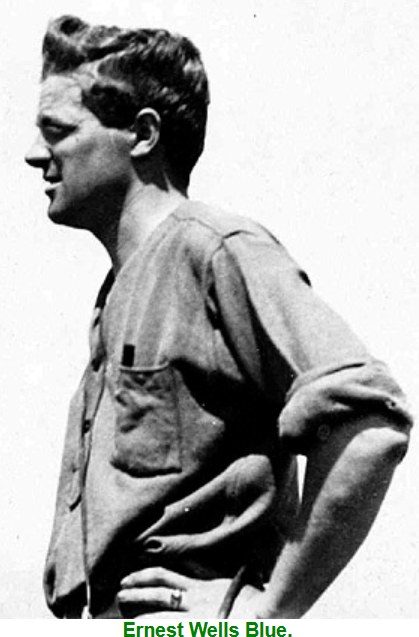
Research edition
This publication reconstructs Ernest Wells Blue’s life from family papers made public by his son Allan G. Blue, Robert Rosenbluth’s memoir and correspondence, forestry-school archives, state land-management records, federal patent and banking records, military research, and specialist histories. It distinguishes contemporary evidence from later recollection and preserves unresolved conflicts rather than smoothing them into a cleaner legend.
Superscript numbers throughout the text correspond to the numbered Sources section. A source can support several consecutive sentences where the context is clear. The closing archival guide identifies records that could materially strengthen a future illustrated or fully archival edition.
THREE FINDINGS THAT SHARPEN THE STORY
THE MEMORIAL
Cathedral Pines is a natural stand of exceptionally large white pine near Seventh Lake. On September 11, 1946, Malcolm Blue was memorialized with a plaque affixed to one of its great pines; after lightning killed that tree, DEC moved the plaque to a stone monument within Cathedral Pines in 1994.¹⁷
THE BANK
Blue’s banking career overlapped his ranger service. In 1950 the Biltmore alumni directory listed him simultaneously as District Forest Ranger and president of the Citizens National Bank of Poland.⁹
THE PUMP
Blue’s strongest claim is not that he invented every component of a backpack pump. The evidence supports a more interesting role: operational adapter, collaborator with D. B. Smith, and the state champion who helped turn sprayer technology into standard wildland-fire equipment.¹² ¹³ ¹⁴
Research judgment
The surviving online record is unusually good for a regional forester of Blue’s generation because his son Allan preserved and shared family papers, and because Robert Rosenbluth’s unpublished memoir and Blue’s later letters preserve first-person detail. But the family history is not an official personnel file. Where it supplies dates, titles, anecdotes, or motives not independently corroborated, this report identifies it as family evidence rather than converting it into institutional fact. The largest remaining gaps are the original 1926 Conservation Commission procurement/test records for the Indian Fire Pump; D. B. Smith corporate correspondence; Blue’s exact bank-presidency dates; his full retirement citation; specific fire-tower projects; and an authoritative copy of the wording on his Biltmore diploma.
Executive findings
Ernest Wells Blue was born on August 3, 1890, on his family’s farm near North Gage in Oneida County. He graduated from Holland Patent school in 1909 and, in 1910–11, attended Carl Alwin Schenck’s Biltmore Forest School at the moment when it had become a traveling professional school. Blue’s cohort worked in Michigan, Germany, and North Carolina. That training was not a conventional four-year college education. It was a compressed, demanding professional apprenticeship in timber estimating, surveying, silviculture, logging, milling, forest economics, and forest protection, with heavy fieldwork. Blue graduated in August 1911. 1678
His first forestry job was timber cruising for Finch, Pruyn & Company on Adirondack holdings. In April 1912 he entered state employment as a laborer at the Saranac Inn tree nursery. Within weeks, Robert Rosenbluth took him to Clinton Prison at Dannemora as principal assistant in an experimental prison-forestry program. Blue’s official title became Foreman (Lumbering), but his work went well beyond planting: he helped run remote inmate camps, surveyed boundaries, investigated timber trespass, and reconstructed old survey evidence. 145
After a year helping Rosenbluth establish New Hampton Farm for New York City’s correction system, Blue returned to forestry in 1915, supervised a million-tree planting project, became a state Forester and then Forestry Field Supervisor, and in September 1917 was appointed District Forest Ranger for Region 3. He first lived at Old Forge and moved to Poland in 1926. He remained in the ranger organization until October 1951, eventually being described as Senior District Forest Ranger. Family-retained retirement material credits him particularly with early forest-fire control and with selecting sites and helping erect Adirondack fire towers. 217
Blue’s best-known technical contribution was not the invention of the backpack sprayer itself. D. B. Smith of Utica already manufactured hand sprayers. The strongest defensible interpretation is that Blue recognized their usefulness for wildland fire, brought an operational problem to a manufacturer in his home county, collaborated on adapting an existing product, tested or promoted the result, and helped secure state adoption. A later fire-history account says New York bought 600 units after tests, using Clark-McNary federal funds, and had about 2,000 four years later. Patent history strongly supports a mid-1920s transition from general portable sprayer to purpose-built backpack fire equipment: a Smith sprayer patent filed in 1921 was issued in June 1925; Myron Smith filed a fire-specific backpack design in October 1928. 121314
The Indian Pump story also contains a genuine historical inconsistency. Modern D. B. Smith successor-company timelines have at times claimed an “Indian Fire Pump” as early as 1910, while the ranger tradition places Blue’s collaboration in 1926 and one modern fire-research summary says the pump reached the U.S. Forest Service in 1925. No accessible contemporary 1910 source was found that proves the branded forest-fire pump existed then. The patent chronology fits the Blue adaptation story better than the 1910 corporate date, but the precise sequence cannot yet be declared closed. Blue should therefore be credited as an important operational innovator and champion of the pump, not simplistically as the sole inventor of backpack firefighting. 12131416
A second major correction concerns banking. Blue did not merely retire from forestry and then become a banker. The 1950 Biltmore alumni directory lists him at the same time as “District Forest Ranger” and “President Citizens National Bank of Poland.” Banking was also a Blue-family institution: his father, A. Grant Blue, had been a director of the Citizens National Bank, and his grandfather Malcolm had headed the earlier Poland National Bank. Rosenbluth’s 1962 memoir later called his former assistant “a retired banker in Poland, New York.” Thus Blue’s public life combined forestry and local finance for at least part of his ranger career. 4910112122
The memorial to Blue’s son Malcolm Leonard Blue, a B-24 navigator killed in France on June 2, 1944, lies among the great white pines of Cathedral Pines near Seventh Lake. On September 11, 1946, a plaque was affixed to one especially large pine there, with Governor Thomas E. Dewey attending the dedication. After lightning killed the memorial tree, DEC staff built a small stone monument in 1994 and moved the plaque to it within Cathedral Pines. 17
Taken together, these findings make Blue’s story richer. He emerges as a practical forester trained in one of the formative schools of American forestry; an unusually young supervisor in correctional forestry; a surveyor and timber-trespass investigator; a ranger whose career spanned the institutionalization of fire control; a locally rooted banker; and a father whose public memorial to a son killed in war still stands beneath Adirondack white pines.
The ground
Blue’s New York
Almost the whole of Blue’s working life fits inside one corner of New York State. He was born near North Gage in Oneida County, trained abroad, and then spent forty years between the Oneida–Herkimer farm country he came from and the Adirondack districts he was paid to protect. The one real exception is New Hampton, the correctional farm in Orange County where he followed Robert Rosenbluth for a year.
About the maps on this page
Two maps recur. The 1890 Colton sheet above is contemporary with Blue’s birth and early career. The coloured detail panels later in the page come from the New York State Department of Environmental Conservation’s Adirondack Map, Centennial Edition, showing land acquisitions through 30 April 1985 — published thirty-four years after Blue retired. It is used here to locate places, not to show the landscape as he found it. On those panels, pink marks Forest Preserve land, the heavy blue line is the boundary of the Adirondack Park, and small solid blue dots mark fire observation towers.
The arc at a glance
Dates and wording are taken from the report’s detailed chronology, which appears in full, with sources, in the research reference below.
- August 3, 1890Born at the Home Farm near North Gage, Oneida County, New York, son of Arthur Grant and Julia Emma Wells Blue.
- Summer 1910Joined Carl A. Schenck’s Biltmore Forest School at the Cummer-Diggins Lumber Company working field near Cadillac, Michigan.
- August 1911Graduated from Biltmore Forest School.
- April 20, 1912Hired by New York Conservation Commission as laborer at Saranac Inn Tree Nursery, 22 cents/hour.
- May 10, 1912Went to Clinton Prison/Dannemora as Robert Rosenbluth’s principal assistant in prison-forestry experiment; initially $2/day.
- March 1, 1914Resigned Clinton position to help Rosenbluth establish New Hampton Farm for New York City correction system.
- Spring 1915Supervised one-million-tree planting project near Paul Smiths; project completed by June 1.
- September 1, 1917Appointed District Forest Ranger, Region 3.
- Early 1926 (retrospective account)Blue, headquartered at Cold Brook, approached D. B. Smith Co. in Utica about adapting an agricultural sprayer for forest fires.
- 1926 (retrospective account)New York reportedly tested and bought 600 Smith Indian Fire Pumps with federal Clark-McNary funds.
- August 2, 1926Blue family moved to Poland, New York.
- 1929Blue surveyed and mapped Cranberry Pond parcel; later survey found his cornering in error.
- June 2, 1944Malcolm Blue killed in France while serving as B-24 navigator, 852nd Bomb Squadron, 491st Bomb Group.
- September 11, 1946Malcolm Blue memorial plaque dedicated on a large white pine near Seventh Lake; Governor Thomas E. Dewey attended.
- 1950Biltmore alumni directory lists Ernest simultaneously as District Forest Ranger and president of Citizens National Bank of Poland.
- October 1, 1951Retired from New York state conservation service.
- February 12, 1974Ernest Wells Blue died, age eighty-three.
- 1994After lightning had killed Malcolm’s memorial pine, DEC staff built a stone monument and moved the plaque into Cathedral Pines.
Prologue — The Pine That Became a Memorial
A traveler on New York Route 28 between Inlet and Raquette Lake can step off the highway and, within minutes, stand among some of the Adirondacks’ great old white pines. The place is Cathedral Pines. The trees are the attraction, but one stone monument changes the nature of the walk. It carries the memory of Second Lieutenant Malcolm Leonard Blue, killed in France on June 2, 1944. 17
Cathedral Pines is a small, naturally established stand of exceptionally large white pines near Seventh Lake, the kind of old Adirondack pine timber whose origin is immediately apparent to a forester or experienced woods observer. On September 11, 1946, a plaque honoring Malcolm was placed on one especially large pine. Governor Thomas E. Dewey attended the dedication. Malcolm’s family had a camp at Golden Beach in Raquette Lake, and his father, Ernest Blue, was by then New York State’s Senior District Forest Ranger. The memorial pine later died after a lightning strike. In 1994 Department of Environmental Conservation crews built a small stone monument and transferred the plaque to it within Cathedral Pines. 17
That is an appropriate monument to Ernest Blue as well, though his name is secondary on it. His professional life was built around the idea that forests were not abstractions. They were places to cruise, map, plant, protect, fight fire in, earn a living from, and return to after loss. A tree already old when Malcolm was born became the family’s memorial. When the tree died, the memorial remained among other trees. In that small continuity lies much of the shape of Ernest Blue’s life.
Home Farm and a Road into Forestry
1890–1910
Ernest Wells Blue was born August 3, 1890, at what his family called the Home Farm near North Gage in Oneida County. His father was Arthur Grant Blue, generally known as A. Grant Blue, and his mother was Julia Emma Wells. Ernest grew up near West Canada Creek and the place known as Blue’s Eddy. His son Allan later remembered Ernest showing him the remains of a log cabin he had made there from trees he cut himself, and recalled the family’s spring work salvaging cedar and other wood deposited by high water for fence posts. 111
The family was rooted in land, agriculture, local business, and public affairs rather than professional forestry. A 1912 county history describes A. Grant Blue as an extensive farmer and livestock dealer with roughly 900 acres in Deerfield and another 700 acres in Herkimer County. He had attended Utica Business College, served in local and state office, and was a director of the Citizens National Bank of Poland. Ernest’s grandfather, Malcolm Blue, had been president of the Poland National Bank. 1011
That background matters. The young Ernest was not raised in an isolated woods household. He grew up where land management, commerce, roads, livestock, local government, and banking met. His later capacity to move easily between a forest ranger district and a bank presidency seems less anomalous when seen from North Gage.
Ernest attended school in Holland Patent and graduated in 1909 in a class of nine, according to the family record. What led him specifically toward forestry is not preserved in a surviving first-person statement. The timing, however, put him in the first generation for whom “forester” was becoming a recognizable American profession. Scientific forestry had only recently acquired schools, state agencies, and a federal service. New York’s own institutions were still evolving. A young man interested in woods work could enter a field whose procedures, professional identity, and public authority were being invented almost in real time. 1
In the summer of 1910, Blue joined perhaps the most distinctive forestry school available to him: Carl Alwin Schenck’s Biltmore Forest School. By then Biltmore was no longer simply a schoolhouse on George Vanderbilt’s estate in North Carolina. It was traveling. Blue joined it near Cadillac, Michigan, on the lands of the Cummer-Diggins Lumber Company. He would spend part of the next year in Germany and then return to North Carolina before graduating in August 1911. 17
Schenck’s Traveling School
1910–1911
Blue’s forestry training deserves more weight than a line in a résumé. Biltmore was a short course only if measured by calendar. It was designed as an immersion in the work of a practicing forester. Schenck’s program mixed technical lectures with relentless fieldwork. Contemporary school material and later scholarship describe students marking trees, grading firewood, estimating logging costs, making seedbeds, planting seedlings, operating sawmill machinery, estimating standing timber, logging, milling, surveying, road building, and bridge building. Schenck also published lecture guides in forest policy and forest protection for his students. 6825
The Forest History Society’s Jonathan Keith Esser collection is particularly useful because Esser was a 1911 Biltmore graduate who traveled through the same working fields at the same time as Blue. His letters from Cadillac, Lindenfels, and Darmstadt in 1910–11 describe the physical rigors of the program, the school’s preference for practical work over purely theoretical study, the daily mix of lectures and field exercises, and direct observation of forestry in Michigan and Germany. Contemporary photographs from Laurence Young’s papers likewise document Biltmore students in Darmstadt, the Adirondacks, Michigan, North Carolina, and other “working fields.” 724
This helps answer a central question about Blue: what did his training actually equip him to do? It equipped him to measure timber, recognize species and forest conditions, survey lines, think about harvest and regeneration, understand logging and mill operations, and treat fire and other forest threats as management problems. It also trained him in Schenck’s entrepreneurial conception of forestry. Biltmore was intended to prepare men who could be useful to landowners and lumber companies, not simply government theoreticians. 68
The program was demanding academically as well as physically. Scholarship based on Biltmore catalogs describes written reports, examinations after courses, a probationary period, and an emphasis on robust health and hard field labor. Students were expected to keep a horse because instruction often took place far from a classroom. 6
It equipped him to measure timber, recognize species and forest conditions, survey lines, think about harvest and regeneration, understand logging and mill operations, and treat fire and other forest threats as management problems.
On what Biltmore actually trained him to do
There is a minor source conflict over cost. Allan Blue’s family history gives tuition as $960. A published analysis based on a 1908 school catalog gives $230 for tuition, fees, and books, plus substantial living, travel, club, and horse expenses; another contemporary-derived cost reconstruction approaches $1,000 for the full year once those extras are included. It is therefore likely that the family figure preserves the approximate total burden of attendance rather than tuition alone, but the exact 1910–11 fee schedule remains to be checked in the Biltmore/Forest History Society archives. 16
It is also safest to describe Blue as a graduate of the Biltmore Forest School rather than attach an unverified modern degree label to him. His son reports that Blue’s diploma was donated to and displayed at the Cradle of Forestry in America. Scholarship on Biltmore indicates that qualifying students could earn a forest-engineer credential, while Biltmore alumni literature used other degree language in some periods. The wording on Blue’s own diploma should be examined before assigning a precise degree title. 16
The crucial point is not the label. Blue had one of the most intensely practical forestry educations available in the United States, and it was international. He saw large-scale lumbering in Michigan and European forestry in Germany. That combination—American timber operations, German silvicultural tradition, hard surveying and estimating, and Schenck’s insistence on practical judgment—fits the work Blue began almost immediately after graduation.
Cruiser, Nursery Laborer, and the Dannemora Experiment
1911–1914
After graduating in August 1911, Blue went to work for Finch, Pruyn & Company of Glens Falls, cruising timber on company holdings in Hamilton and Essex counties. The job put his Biltmore mensuration and woods skills directly to use. It also placed him in the Adirondacks that would define most of his career. 1
On April 20, 1912, Blue entered New York State service at a very low rung: laborer at the Saranac Inn Tree Nursery, earning twenty-two cents an hour. That apparent step down in title opened a far larger opportunity. Robert Rosenbluth, a young forester directing state institutional forestry work, was trying to demonstrate that prison lands could be managed and reforested with inmate labor. After a destructive riot at Clinton Prison in Dannemora, officials allowed him to try a camp. Rosenbluth chose Blue as his principal assistant. On May 10, 1912, the two went to Dannemora. Blue was twenty-one, turning twenty-two that summer. 14
The family history gives Blue’s initial wage as two dollars a day and records that on September 9 he received the official title Foreman (Lumbering) at $1,200 a year. A surviving business card apparently styled him “Forester of Clinton Prison,” though Allan Blue carefully notes that he could not establish whether that was an official civil-service title. That distinction is worth preserving: Blue unquestionably did forester’s work at Clinton, but his documented personnel title was not necessarily “Prison Forester.” 1
The correctional-forestry experiment was extraordinary. Crews of prisoners lived and worked in remote camps many miles from the prison. Family recollections say the camps operated without armed guards and became known among inmates as “Camp Blue.” Blue’s son preserved a framed tribute signed by inmates. Rosenbluth’s later memoir independently says the Dannemora forest camps expanded, remained unguarded, and accomplished substantial restoration work. 14
More important for Blue’s professional development, the job became a school in land evidence. The prison owned a large Adirondack tract, and the forestry crews discovered indications of timber trespass. Rosenbluth’s memoir says the work uncovered widespread trespass and recovered thousands of dollars for the state. Blue’s own 1961 letter to Rosenbluth, reproduced in the correction-history archive, shows how involved he was. He described searching for original survey evidence in Township 5 of the Old Military Tract, reconciling old allotment lines, locating corners, and working with survey crews to encircle a township. 5
This is one of the most important pieces of evidence for understanding Blue. He was not merely a young man supervising tree planting. By his early twenties he was reading landscape history through bearings, corner evidence, old surveys, and timber use. He was learning the forensic side of public forestry: where exactly is the state line, who crossed it, what was cut, and what can be proven? Those skills later belonged naturally to a ranger organization responsible not only for fire but also for protection of state lands.
Blue’s role at Dannemora also exposed him to a management problem as difficult as any technical forestry exercise: how to get work done through people under unusual constraints. The family story of prisoners shaving him with a straight razor cannot be independently verified and should remain family recollection. The broader fact—that remote inmate forest camps operated and that Blue served as Rosenbluth’s principal assistant—is corroborated by Rosenbluth’s memoir and the surviving correspondence. 145
New Hampton and the Return to the Adirondacks
1914–1917
Rosenbluth’s correctional work pulled Blue temporarily away from forestry. On March 1, 1914, Blue resigned his Clinton Prison position to help establish New Hampton Farm near Middletown for New York City’s reformatory system. The project was intended to employ young offenders in agricultural work and produce food for city institutions. Blue again served as Rosenbluth’s principal assistant. When he left on March 31, 1915, Correction Commissioner Katharine Bement Davis gave him a strong recommendation. 2
Allan Blue believed his father had agreed to give Rosenbluth only a year because he wanted to return to forestry, but he explicitly wrote that he could not prove this. The chronology nevertheless supports the larger point. Blue left New Hampton and promptly went back to tree planting. At Lake Pond Camp near Paul Smiths he supervised a state project to plant one million trees by June 1. A surviving employment chronology says his crew numbered nineteen on April 29. The project met the deadline. 2
On June 1, 1915, Blue received a temporary appointment as a state Conservation Department Forester at $1,200 a year. One month later, on July 1, he was appointed Forestry Field Supervisor at $1,400. He wrote to his future wife, Lulu Belle Davis, that the appointment meant “the realization of many dreams.” 2
He and Lulu married in Herkimer on April 15, 1916. The next morning he had to be at work near Lake Clear. Their early married life was literally camp life. Family records describe them living in a tent while he supervised planting, with Lulu buying hobnailed boots and Ernest building a small water wheel that drove a salvaged telephone hand-crank mechanism to produce a six-volt light. The details come from family papers, but they capture the practical temperament visible elsewhere in the record: a preference for making a system work with what was available. 2
On September 1, 1917, Blue was appointed District Forest Ranger for Region 3. His son described it as a district of more than two million acres in and north of the Adirondack Park, one of only five districts in the state. Ernest and Lulu moved to Old Forge later that month. 2
The title “Forest Ranger” can obscure how much Blue had already done by then. At twenty-seven he had completed an international practical forestry program, cruised timber for a major paper company, worked in a state nursery, supervised prison forestry camps, conducted boundary and trespass investigations, helped build a correctional farm, supervised mass reforestation, and served as a state forester and field supervisor. Ranger service was not the beginning of his forestry career. It was the point at which those threads were gathered into one job.
District Forest Ranger
1917–1951
Blue’s ranger career lasted thirty-four years. He began in Old Forge in 1917 and moved to Poland on August 2, 1926, remaining associated with that village for the rest of his life. The move is significant because Poland lay closer to his Oneida-Herkimer family network and to Utica—where D. B. Smith & Company manufactured sprayers. 2
The early New York ranger system was a different institution from the modern rescue-oriented image of a forest ranger. Fire detection and suppression were central, but rangers also protected state land, dealt with timber trespass, enforced conservation law, coordinated local fire wardens, inspected conditions, worked with towers and communications, and operated over enormous territories. Blue’s earlier work in survey evidence and land protection therefore belonged directly in the ranger toolkit.
Family-retained retirement correspondence says that when Blue retired he was especially cited by Conservation Commissioner Perry B. Duryea for early forest-fire-control work, including selection of fire-tower sites and erection of towers. This research did not locate the original Duryea citation or a tower-by-tower list, so the claim should remain attributed to the family archive rather than expanded beyond it. It is nevertheless plausible within the documented scope of a district ranger’s duties, and the family papers apparently derived much of Blue’s employment chronology from the retirement dispute itself. 2
One surviving official land-management record gives a different glimpse of his field work. A 2018 Grass River Wild Forest plan recounts that in 1929 Ernest Blue surveyed and mapped the Cranberry Pond parcel, found no evidence of earlier monuments or markings, and set four new corners. A later 1967 survey concluded that Blue’s location was in error. 20
That is useful evidence precisely because it is not flattering. It confirms that Blue was doing real boundary survey work as a ranger and reminds us that such work was difficult and fallible. The Adirondack landscape often asked surveyors to recover century-old paper lines from burned, logged, regrown, and poorly marked ground. Blue’s record should not be made heroic by excluding the occasions on which later evidence corrected him.
The length of Blue’s service matters more than any single assignment. He entered professional forestry when state institutions were young and stayed through the maturation of organized detection, communications, equipment, and suppression. He would have seen a transition from fire fighting dependent on local manpower, hand tools, and improvised transport toward systems built around towers, telephone and radio communication, purpose-designed pumps, vehicles, and increasingly standardized equipment. His career was a bridge between experimental conservation and professionalized wildfire organization.
Blue retired from state service on October 1, 1951. His son reports that early personnel records were initially missing and that Rosenbluth helped establish credit for Blue’s earliest service. The eventual retirement correspondence became a source for the family’s detailed chronology. Allan Blue also wrote that his father was the longest-serving employee of the Conservation Department at retirement. This report has not found an independent statewide seniority list to prove that superlative, so it should be treated as a family-reported statement based on retirement material. 2
A Pump from Utica
If Ernest Blue is remembered outside Adirondack ranger history, it is most likely for the Indian Fire Pump. The story is often told as an invention story: Ranger Blue saw an agricultural sprayer made by D. B. Smith & Company in Utica, recognized what it could do against forest fire, and caused the company and state to turn it into a standard fire-fighting tool. The underlying achievement is real enough to deserve attention, but the word “invented” is too simple for the evidence.
The technological starting point was already present. D. B. Smith had long made agricultural sprayers. A patent filed by DeWane B. Smith on December 9, 1921, and issued June 30, 1925, described a portable, hand-operated sprayer with a receptacle and reciprocating pump. It was not yet framed in the patent title as a forest-fire backpack unit. 13
A modern historical review published by Rural Fire Research in New Zealand gives the most specific version of Blue’s role. It says that, after an earlier Vemorel pump proved unsatisfactory, District Ranger Ernest Blue, headquartered at Cold Brook, approached D. B. Smith in early 1926. According to that account, Blue and the company made minor modifications to an existing product, tested the result, and produced an effective wildland fire pump. The Conservation Commission then bought 600 units with federal funds available under the Clark-McNary program; four years later, it says, the department had 2,000. 12
The family history independently preserves essentially the same mechanism, though without the procurement figures: Blue recognized the fire-fighting potential of a D. B. Smith agricultural pump and convinced both the company and the state. His son remembered that it became standard equipment and that thousands eventually went into service. 2
Patent chronology adds strong circumstantial support. On October 20, 1928, Myron H. Smith filed a patent explicitly titled “Portable Fire Extinguisher and Sprayer.” The design combined a tank, straps for carrying it on a person’s back, flexible hose, and manually operated cylindrical pump. Later patents continued refining the backpack fire/sprayer concept, including operator comfort and insulation. 1415
How the adaptation appears to have worked
The report’s reading of the evidence, set out in four steps. Each step is drawn from the sources cited in this chapter; the sequence is a summary of that argument, not an additional claim.
Problem
An unsatisfactory pump
New York rangers needed to carry water where no engine or hose line could reach. A Vemorel pump then in use proved unsatisfactory.
Before 1926Angle
A sprayer maker in Utica
D. B. Smith & Company, in Blue’s home county, already built hand-operated agricultural sprayers. Blue, headquartered at Cold Brook, approached the company.
Early 1926, retrospective accountTest
Minor modifications, then trial
Blue and the company modified an existing product and tested the result in the field. The patent record shows a general sprayer filed in 1921 and issued in 1925, and a fire-specific backpack design filed in 1928.
1925–1928Adoption
Six hundred, then thousands
The Conservation Commission bought 600 units with federal Clark-McNary funds; a retrospective fire history says the department had about 2,000 four years later.
1926, and circa 1930Taken together, the documents suggest a process of adaptation rather than a single Eureka moment. Smith had a sprayer technology. Blue had an operational need and a ranger’s understanding of where water was useful and where heavy apparatus could not go. The collaboration appears to have translated a general-purpose sprayer into a durable fire tool, and Blue’s position in the state system gave him a route to testing and procurement. That is a substantial form of invention: not creating every component from scratch, but recognizing a new use, specifying what had to change, proving it in practice, and getting an organization to adopt it.
The pump’s significance is easy to underestimate from the perspective of modern engines and aircraft. Wildland fire often occurs where no hose line or vehicle can reach. Water carried on the back can be placed directly on a hot spot, a smoldering log, duff, or a small edge of active fire. The classic Indian Pump carries roughly five gallons—about twenty liters—and uses a hand “trombone” pump connected by hose. It is simple, refillable, and field-repairable. A 1940s D. B. Smith advertisement promoted Indian pumps for quick control of early fires; later advertisements showed the product as standard equipment for forestry and local fire organizations. 1223
Blue’s contribution also fits his background unusually well. D. B. Smith was in Utica, in his home county. Blue had grown up around practical agriculture and machinery, had been trained at a school that treated forest utilization and protection as hands-on problems, and had spent years organizing fire control over a huge district. The connection between a ranger and an agricultural-equipment maker was not accidental cross-pollination; it was exactly the kind of local practical network through which early forestry technology often advanced.
The 1910 problem
There is, however, a chronological problem that should not be hidden. Modern successor-company materials have at times placed the “Indian Fire Pump” in 1910. Another modern fire-research source says the Smith Indian was introduced to the U.S. Forest Service in 1925 but then dates Blue’s approach to Smith to early 1926. Those statements cannot all describe the product’s origin in the same sense. 12
No accessible contemporary 1910 advertisement, catalog, patent, or state document was found in this research that establishes a branded Indian Fire Pump in that year. By contrast, the patent sequence is concrete: a general hand sprayer was filed in 1921 and issued in 1925; a fire-specific backpack apparatus was filed in 1928. The sequence is compatible with a 1925–26 field adaptation and subsequent refinement. It does not by itself prove that Blue was first, and it does not rule out earlier unpatented fire use, but it makes the later corporate 1910 date questionable enough that it should not displace the ranger account without primary evidence. 1314
The New York State Forest Fire Lookout Association has called Blue the “Father of the Indian Fire Pump” in ranger-history circles. The phrase is best understood as retrospective recognition of his role in turning the Smith sprayer into operational forest-fire equipment and promoting it within New York, not as a patent-law claim. 16
There is also a D. B. Smith advertising painting that has sometimes been said to portray Blue. The lookout association records that the painting belonged to D. B. Smith, appeared in advertisements for at least twenty-five years, and was displayed in the 1985 Forest Ranger Centennial exhibit in Albany. A company supervisor later suggested that, because of the period ranger uniform and resemblance, the painted ranger might be Blue. The association itself calls the identification unsubstantiated. The image is an excellent artifact for a future illustrated publication; the sitter’s identity should not be stated as fact. 16
The unresolved archival target is clear: the original Conservation Commission correspondence or purchase file for the 600 pumps, test reports, D. B. Smith catalogs from roughly 1924–29, and any company correspondence with Blue. Those documents could settle whether 1925 and 1926 represent prototype, federal introduction, New York testing, or separate stages of the same development.
Banker in a Ranger’s Uniform
Blue’s banking career initially looks like a late-life departure from forestry. Rosenbluth wrote in his 1962 memoir, “My assistant, Ernest Blue, is now a retired banker in Poland, New York.” That phrase encouraged the natural assumption that Blue left the woods and entered banking. 4
The 1950 Biltmore Forest School reunion directory changes the picture. Its alumni entry for Ernest W. Blue, class of 1911, gives two roles at once: “District Forest Ranger” and “President Citizens National Bank of Poland.” Blue did not retire from the Conservation Department until October 1951. At least by 1950, therefore, he was simultaneously a senior public forester and the president of a local national bank. 9
The 1950 entry
The Biltmore alumni reunion directory of 1950 lists Ernest W. Blue, class of 1911, under two roles at once: District Forest Ranger, and President, Citizens National Bank of Poland. He did not retire from the Conservation Department until October 1951.
That combination makes more sense in family context. Blue’s father had been a director of the Citizens National Bank for a decade by the time a 1912 Oneida County history was published. His grandfather had been president of the earlier Poland National Bank. Federal records show that the Citizens National Bank of Poland received national charter 9804 in 1910 with $50,000 capital, succeeding the National Bank of Poland; it later merged into Oneida National Bank and Trust Company in October 1964. 10112122
The exact date Ernest became bank president remains unresolved. So does the day-to-day nature of the office. In a small community bank, the presidency could combine governance, local standing, and business work in ways different from a modern full-time corporate chief executive. The evidence does not support assuming either that the position was merely honorary or that Blue worked a conventional second full-time job while ranger. What it proves is overlap.
This is more than a biographical curiosity. Forestry and banking both involve judgments about assets whose value unfolds over time. Blue’s father and grandfather had already linked land, agriculture, public life, and finance. Ernest’s professional forestry training added another way of valuing land—through timber, protection, regeneration, and long-term management. The bank presidency situates him not simply as a state employee stationed in Poland but as one of the village’s civic and financial figures.
By 1962 Rosenbluth could call him a retired banker, suggesting that Blue had also left that role by then. The accessible record does not yet give the precise retirement date. Bank directors’ minutes, annual reports, Comptroller reports listing officers, or local newspaper notices are the best next sources.
Malcolm
Ernest and Lulu Blue had three sons: Douglas King, Malcolm Leonard, and Allan Grant. Malcolm was born July 26, 1920, at Old Forge, during his father’s ranger years. Family material places the boys in a household shaped by the Adirondacks and by Ernest’s field career. 318
During World War II, Malcolm became a second lieutenant in the U.S. Army Air Forces and trained as a navigator. By June 1944 he was assigned to the 852nd Bombardment Squadron, 491st Bombardment Group, Second Air Division, Eighth Air Force. On June 2, only days before the Normandy invasion, he flew as navigator aboard B-24H Liberator serial 42-95310, code 3Q-W, piloted by First Lieutenant William J. Evans. Their target was Brétigny airfield south of Paris. 18
The aircraft was lost near Beaumont-sur-Oise. Aircrew Remembered’s reconstruction, drawing on Missing Air Crew Report material, identifies Malcolm as killed in action at age twenty-three. A French Comète-network research page reconstructing the fate of crew members says the B-24 was brought down by flak, the crew bailed out, and men descending by parachute were fired upon; it reports that Malcolm’s parachute was burned and that he died on impact. That specific final sequence comes from a later reconstruction and should be treated more cautiously than the basic official facts of aircraft, mission, date, and death. 1819
Malcolm was first buried in France and ultimately reinterred at Epinal American Cemetery, Plot A, Row 32, Grave 56. He received the Purple Heart. 18
For Ernest and Lulu, the loss was personal and permanent. Yet the surviving online family history does not provide a letter from Ernest describing the moment notification arrived or his private grief. It would be irresponsible to invent one. What survives publicly is what the family and community did two years later: attach Malcolm’s memory to a living Adirondack tree.
The Memorial Pine
1946
The official DEC management plan is unusually precise. On September 11, 1946, a memorial plaque was erected on a large white pine near Seventh Lake in honor of Malcolm. The plan identifies Malcolm as a Poland resident and notes that the Blue family had a camp at Golden Beach in Raquette Lake. Ernest is identified as New York State’s Senior District Forest Ranger. Governor Thomas E. Dewey attended the dedication. 17
The setting was already remarkable: a mature natural stand of very large white pine, with the memorial centered on one particularly imposing tree. The choice was fitting for the son of a forester. Rather than creating a new landscape, the dedication used one of the Adirondack forest’s own great pines as the physical focus of Malcolm’s memorial.
The tree did not survive indefinitely. DEC records say lightning felled it. In 1994 DEC Operations staff built a small stone monument and moved the plaque into Cathedral Pines. Thus the memorial has had two physical forms: first plaque-on-tree, then plaque-on-stone among the pines. 17
Because the setting is integral to the memorial, any final illustrated or field-based edition should photograph the present monument together with the trail, the surrounding large white pines, and the broader Cathedral Pines stand. Local archives should also be searched for photographs of the September 1946 dedication with Governor Dewey.
Retirement and the Last Walks
1951–1974
Blue retired from state service on October 1, 1951, after a forestry career that had begun forty years earlier with Finch, Pruyn. In between were almost every practical form of early New York forestry: timber cruising, nursery work, reforestation, prison forestry, surveying and trespass investigation, field supervision, ranger administration, fire-tower work, and wildfire equipment development. 12
Retirement did not erase the identity. In the materials his son preserved, Blue continued corresponding with old forestry associates. Rosenbluth sent him a copy of his memoir in 1962. Blue’s reply recalled the bugler at Dannemora and how the call echoed through the Saranac valley—evidence that a half-century later the sounds and landscape of his first major assignment remained vivid. 4
Lulu Belle Blue died September 14, 1963. In 1964 Ernest married Mildred P. Harter, Lulu’s niece. Family history records one last small ritual: in December 1973, at eighty-three, Ernest made his final trip into the woods to cut a Christmas tree. He died February 12, 1974. 23
The family account also preserves the story of his proposal to Lulu: he reportedly blazed a beech as though marking a survey corner. It is a story told by people who knew him and therefore worth preserving as family memory, but it is also almost too perfectly emblematic. Blue seems to have interpreted the world through field practice. Survey marks, improvised machinery, tree planting, pumps, bank ledgers, and memorial pines all belong to a life in which abstractions became useful only after they were made operational.
What Ernest Blue Actually Contributed
Blue was not a nationally celebrated theorist. He did not leave a famous forestry textbook or a great public tract of land bearing his name. His significance is more characteristic of the generation that built forestry as an institution: he made systems work on the ground.
His training connected the German-derived technical forestry of Schenck to the rough practical conditions of American lumbering and Adirondack public land. His early Dannemora work connected silviculture to correctional administration and land-law evidence. His ranger career connected a young state conservation structure to local wardens, towers, communications, surveys, and fire suppression. His work with D. B. Smith connected an agricultural manufacturer to a problem in wildland fire. His banking role connected public forestry to the civic economy of the village where he lived.
It shows something more operationally persuasive: an experienced ranger seeing a useful mechanism in another industry, approaching a nearby manufacturer, adapting it to a field need, and pushing a public organization to adopt it.
What the evidence supports
The Indian Pump is the clearest example of his style. The strongest evidence does not show Blue sitting at a drafting table inventing every component. It shows something more operationally persuasive: an experienced ranger seeing a useful mechanism in another industry, approaching a nearby manufacturer, adapting it to a field need, and pushing a public organization to adopt it. That kind of innovation is often invisible because patents and corporate histories favor component inventors while agency histories favor formal programs. Blue seems to have occupied the middle—the person who recognized what could work.
That judgment should remain bounded by the evidence. The surviving online record does not yet prove the exact 1926 meeting, identify the D. B. Smith engineer who worked with Blue, or provide the state’s first purchase order. The 1910 corporate-history claim remains unresolved. Blue deserves credit, but the credit is strongest when stated precisely: he was a key New York ranger advocate and likely co-developer of the adaptation that turned Smith sprayer technology into a widely adopted wildland-fire backpack pump. 12131416
The memorial offers a different window into Blue’s life. One of Cathedral Pines’ great white pines was chosen to carry Malcolm’s plaque; a governor came to the dedication; lightning eventually killed the tree; and the plaque was preserved on stone within the same stand. For a forester whose life had been spent cruising, mapping, protecting, and working among New York forests, the setting gave his son’s memorial an unusually direct connection to the landscape that had shaped the family.
Closing assessment
Ernest Wells Blue belongs to a class of early professional foresters whose importance is easiest to see in the systems they left behind rather than in a single celebrated doctrine. His career ran from Biltmore’s horse-and-field-course model of forestry education to the standardized equipment and administrative structure of mid-century fire control. He crossed private timber, state nursery work, correctional forestry, reforestation, survey and trespass work, ranger administration, technology adoption, and local banking. His son’s memorial links that public career to private loss.
The most persuasive version of Blue’s biography is therefore not “the man who invented the Indian Pump,” although the pump deserves a central chapter. It is the story of a practical New York forester who repeatedly stood where institutions met the woods: between old survey notes and a contested boundary, between prisoners and a reforestation plan, between an agricultural sprayer and a forest fire, between a ranger district and a village bank, and finally between a family’s loss and one great pine beside Seventh Lake.
Appendix — Ernest Blue Through the Lens of High Agency
An interpretive lens, applied after the fact
High agency is a modern term, not one Ernest Blue would have used about himself. Used carefully, however, it provides a useful lens for understanding the pattern visible across his career. Forest Business School defines high agency not as swagger, optimism, or raw work ethic, but as the learned capacity to see more options, test more angles, act before perfect information arrives, challenge defaults that deserve to be challenged, and improve the system after reality answers back. Its three-part model emphasizes clear thinking, bias to action, and productive disagreeability. 2627
That framework fits Blue unusually well because his record is not primarily a story of personal heroics. Again and again he encountered a practical constraint, worked out what part of it was actually fixed, made a useful move with the resources at hand, and then helped turn the result into a repeatable practice. The fit is strongest when high agency is treated as an operating habit rather than a personality label.
FBS WORKING TEST
When the ordinary path is blocked, who asks the clearest questions, makes the first useful call, tests the next angle, and keeps learning until the problem changes shape? 26
Capability Before Status
Blue’s first high-agency pattern appears before he held much authority. His 1910–11 education at Carl Schenck’s Biltmore Forest School was intensely practical: timber estimating, surveying, silviculture, logging, milling, forest economics, and protection taught through fieldwork in the United States and Europe. When he entered New York State service in April 1912, however, he did so as a laborer at the Saranac Inn Tree Nursery earning twenty-two cents an hour. He did not wait for a title that matched his training. Within weeks Robert Rosenbluth pulled him into the experimental prison-forestry work at Dannemora, where Blue soon became principal assistant and Foreman (Lumbering). 145678
The work itself demanded more than routine forestry. Blue helped run remote inmate camps, supervised restoration work, recovered old boundary evidence, investigated timber trespass, and reconstructed survey lines in difficult Adirondack country. In FBS terms, this is the difference between waiting for a job description and making useful contact with the real problem. Blue’s formal status was modest; the responsibility he accepted was not. 145
From Assignment to System
A second pattern is Blue’s tendency to move beyond the immediate assignment. After helping Rosenbluth establish New Hampton Farm, he returned to forestry and in 1915 supervised a state planting project charged with putting one million trees in the ground by June 1. The crew met the deadline. Soon afterward Blue advanced from temporary forester to Forestry Field Supervisor and, in 1917, District Forest Ranger. By the time he entered the ranger service at twenty-seven, he had already worked in private timber, a state nursery, correctional forestry, boundary and trespass investigation, institutional agriculture, and mass reforestation. 2
The significance is not that Blue changed jobs frequently. It is that he accumulated working knowledge across systems and then carried it forward. His ranger career extended for thirty-four years, through a period when New York fire protection evolved from local manpower and improvised equipment toward towers, communications, standardized pumps, vehicles, and more formal administration. Family-retained retirement material credits him with early fire-control work including tower siting and erection; official records independently show him still doing difficult survey work in the field. 220
This is close to the FBS idea that high agency becomes durable when a useful action is converted into a system. Blue’s value was not simply that he could personally work hard in the woods. His career repeatedly put him in positions where better organization, better evidence, better infrastructure, or better equipment could make the next person’s work easier and more reliable. 2627
The Indian Fire Pump: The Clearest High-Agency Episode
The Indian Fire Pump episode is the strongest single illustration. New York rangers had a practical problem: the portable pump then in use was unsatisfactory, yet wildland firefighters needed a way to carry and apply water where engines and hose lines could not reach. Blue did not treat “bad forest-fire pump” as a problem that had to be solved entirely inside the forestry bureaucracy. He looked sideways. D. B. Smith & Company in Utica already knew how to build agricultural sprayers. According to the strongest surviving fire-history account, Blue approached the company in early 1926, minor modifications were made, the result was tested, and New York then purchased 600 units with Clark-McNary funds. Within several years the state reportedly had about 2,000. 121314
In FBS language, this is angle-seeking: looking for a legitimate side door when the obvious path is blocked. Blue did not need to invent the pressure vessel, pump cylinder, straps, hose, and manufacturing process from first principles. His contribution was to connect an operational need with an existing capability, help adapt it, test it in the field, and use his institutional position to move the successful solution toward adoption. The distinction matters. A shortcut avoids responsibility; a side door finds a workable path the default process hides. 121627
That is also why the label “Father of the Indian Fire Pump,” while understandable, can obscure the more instructive achievement. Blue’s agency lay less in solitary invention than in translation: forestry need into equipment requirement, local manufacturer into collaborator, field trial into evidence, and evidence into procurement. High agency often looks exactly like this—less a flash of genius than a short learning loop carried all the way into a working system. 1213141626
Productive Disagreeability, Not Rule-Breaking
Blue is also useful because he corrects a common misunderstanding of high agency. He was not an anti-bureaucratic outsider. Most of his working life was spent inside public institutions. His ranger career, the pump adoption, the correctional-forestry experiments, and his later role as president of the Citizens National Bank of Poland all depended on trust, procedure, reputation, and institutional legitimacy. In 1950 he was listed simultaneously as District Forest Ranger and bank president, showing that his public-service and civic-financial roles overlapped rather than following one another neatly. 9102122
What FBS calls “disagreeability” is therefore best understood here as independence from bad defaults, not reflexive opposition. Blue was willing to ask whether the existing equipment was good enough, whether a prison forest could be managed differently, whether old boundary evidence could be reconstructed, and whether expertise from one industry could solve a problem in another. But he generally worked through legitimate channels to make the change stick. That combination—question the default, respect the real constraint, build the better arrangement—is closer to mature high agency than rule-breaking for its own sake. 2627
High Agency Is Not Infallibility
The high-agency lens is most useful when it does not become hero worship. Blue made mistakes. A 1929 survey and map he prepared for the Cranberry Pond parcel was later judged by a 1967 survey to have located the parcel incorrectly. The episode belongs in the story because agency does not guarantee correctness. The FBS framework explicitly treats action as valuable because it creates contact with reality and gives the actor something to update. A person can be decisive, skilled, and wrong. The test is whether the underlying method remains open to evidence and correction. 202627
The same caution applies to the limits of the record. Family papers portray Blue as ingenious and practically minded—building a small water-powered generator while living in a field camp is a memorable example—but some character details survive only through family recollection. The public evidence supports describing him as capable, persistent, technically curious, trusted with responsibility, and unusually willing to cross functional boundaries. It does not justify inventing private motives, claiming that every decision reflected a conscious philosophy of agency, or turning ordinary endurance and family loss into business-school lessons. 2
What Blue Offers Forest Business School
Blue makes a particularly strong FBS case because his career demonstrates high agency without the modern trappings often attached to the term. He was not a startup founder, a self-promoter, or a professional contrarian. He was a working forester and public servant whose agency was expressed through ordinary professional problems: an inadequate tool, an uncertain boundary, a planting deadline, a difficult workforce, a huge ranger district, and institutions that had to function in the real world.
He did not confuse status with usefulness. A professionally trained forester entered state service as a laborer and quickly made himself useful on harder problems. 145
He moved across disciplinary boundaries. Forestry, surveying, corrections, agriculture-equipment manufacturing, fire control, and banking were not isolated compartments in his working life. 2912
He looked for side doors rather than shortcuts. The Indian Pump solution came from another industry, but it was tested and carried through institutional adoption. 12131427
He turned individual actions into durable capacity. Reforestation, ranger infrastructure, standardized equipment, and administrative responsibility mattered because they improved what the system could do after the immediate problem had passed. 21216
He demonstrates that high agency can be quiet. The historical record shows little appetite for theatrical self-presentation; the pattern is visible chiefly in the work itself. 124
For FBS, the useful lesson is not “be like Ernest Blue” in the abstract. It is more concrete: when a working constraint appears, separate what is truly fixed from what is merely customary; find the next legitimate angle; take an informative action before the problem goes stale; and, when the action works, build the learning into the system. Blue’s career offers unusually tangible historical evidence of that pattern. 2627
Seen this way, the Indian Pump is not an isolated clever story. It is the most visible expression of a career-long habit: make useful contact with reality, connect things that other people keep in separate boxes, and leave the working system more capable than you found it.
Research reference
The report’s reference apparatus, complete and unabridged. Each panel opens in place.
Detailed chronology 35 entries
| DATE | EVENT / EVIDENCE |
|---|---|
| August 3, 1890 | Born at the Home Farm near North Gage, Oneida County, New York, son of Arthur Grant and Julia Emma Wells Blue. 111 |
| 1909 | Graduated from school in Holland Patent, family account says in a class of nine. 1 |
| Summer 1910 | Joined Carl A. Schenck’s Biltmore Forest School at the Cummer-Diggins Lumber Company working field near Cadillac, Michigan. 17 |
| Fall/winter 1910–11 | Biltmore field training in Germany, including Darmstadt; later returned with school to western North Carolina. 17 |
| August 1911 | Graduated from Biltmore Forest School. 19 |
| Late 1911–April 1912 | Timber cruiser for Finch, Pruyn & Company on Hamilton and Essex County holdings. 1 |
| April 20, 1912 | Hired by New York Conservation Commission as laborer at Saranac Inn Tree Nursery, 22 cents/hour. 1 |
| May 10, 1912 | Went to Clinton Prison/Dannemora as Robert Rosenbluth’s principal assistant in prison-forestry experiment; initially $2/day. 14 |
| September 9, 1912 | Official title Foreman (Lumbering), $1,200/year. 1 |
| March 1, 1914 | Resigned Clinton position to help Rosenbluth establish New Hampton Farm for New York City correction system. 2 |
| March 31, 1915 | Resigned New Hampton; returned to forestry. 2 |
| Spring 1915 | Supervised one-million-tree planting project near Paul Smiths; project completed by June 1. 2 |
| June 1, 1915 | Temporary appointment as state Forester, $1,200/year. 2 |
| July 1, 1915 | Appointed Forestry Field Supervisor, $1,400/year. 2 |
| April 15, 1916 | Married Lulu Belle Davis in Herkimer; continued field planting work. 2 |
| September 1, 1917 | Appointed District Forest Ranger, Region 3. 2 |
| September 29, 1917 | Family moved to Old Forge. 2 |
| July 26, 1920 | Son Malcolm Leonard Blue born at Old Forge. 18 |
| 1925–26 | Period in which Smith portable sprayer technology and Blue’s reported forest-fire adaptation converge; exact sequence unresolved. 1213 |
| August 2, 1926 | Blue family moved to Poland, New York. 2 |
| Early 1926 (retrospective account) | Blue, headquartered at Cold Brook, approached D. B. Smith Co. in Utica about adapting an agricultural sprayer for forest fires. 12 |
| 1926 (retrospective account) | New York reportedly tested and bought 600 Smith Indian Fire Pumps with federal Clark-McNary funds. 12 |
| 1929 | Blue surveyed and mapped Cranberry Pond parcel; later survey found his cornering in error. 20 |
| circa 1930 | Retrospective fire history says New York had about 2,000 Indian Fire Pumps. 12 |
| October 20, 1928 / March 31, 1931 | Myron H. Smith filed / received patent for a backpack “Portable Fire Extinguisher and Sprayer.” 14 |
| June 2, 1944 | Malcolm Blue killed in France while serving as B-24 navigator, 852nd Bomb Squadron, 491st Bomb Group. 1819 |
| September 11, 1946 | Malcolm Blue memorial plaque dedicated on a large white pine near Seventh Lake; Governor Thomas E. Dewey attended. 17 |
| 1950 | Biltmore alumni directory lists Ernest simultaneously as District Forest Ranger and president of Citizens National Bank of Poland. 9 |
| October 1, 1951 | Retired from New York state conservation service. 2 |
| 1962 | Rosenbluth memoir describes Ernest as a retired banker in Poland. 4 |
| September 14, 1963 | Lulu Belle Blue died. 2 |
| 1964 | Ernest married Mildred P. Harter. 2 |
| December 1973 | Family history records his last woods trip, to cut a Christmas tree. 2 |
| February 12, 1974 | Ernest Wells Blue died, age eighty-three. 23 |
| 1994 | After lightning had killed Malcolm’s memorial pine, DEC staff built a stone monument and moved the plaque into Cathedral Pines. 17 |
Evidence notes and cautions what the record will and will not carry
- The Malcolm Blue memorial
- In 1946 a plaque honoring Malcolm was affixed to one large white pine within the natural Cathedral Pines stand near Seventh Lake. After lightning killed that tree, DEC moved the plaque to a stone monument within Cathedral Pines in 1994. 17
- The bank career
- Banking overlapped Blue’s ranger career. He was listed in 1950 as both District Forest Ranger and president of the Citizens National Bank of Poland. 9
- The pump
- Blue should not be described without qualification as the inventor of the backpack pump. D. B. Smith had preexisting sprayer technology. Evidence best supports Blue as operational adapter, collaborator, tester/promoter, and the critical state advocate for fire use. 121314
- The 1910 corporate date
- A modern successor-company claim that the “Indian Fire Pump” dated to 1910 conflicts with a 1925–26 development/adoption narrative and with the patent chronology. No contemporary 1910 proof was found during this research.
- Biltmore credential
- Blue definitely graduated from Biltmore in 1911; the exact wording of his diploma/degree should be verified from the diploma itself before publication calls it a particular academic degree. 16
- Biltmore cost
- The family’s $960 “tuition” figure may describe total attendance cost. Period catalog-derived scholarship gives much lower tuition/fees/books plus large living, travel, club, and horse expenses. 16
- “Forester of Clinton Prison”
- A family-preserved business card used this phrase, but Allan Blue himself could not confirm it as an official state title. “Foreman (Lumbering)” is the documented 1912 personnel title. 1
- Longest-serving employee
- Allan Blue says his father was the Conservation Department’s longest-serving employee when he retired. The original retirement citation/seniority roster was not located online. 2
- Fire towers
- Family retirement material credits Blue with site selection and erection of Adirondack fire towers, but this research did not identify a complete list of towers directly attributable to him. 2
Archival targets for a second edition where to look next
The following records are the highest-value next steps because they could resolve the remaining factual gaps rather than simply add more secondary repetition.
- New York State Archives / DEC historical personnel records
- Ernest W. Blue personnel file, retirement computation, Duryea citation, District 3 annual reports, fire records, tower construction/site correspondence, ranger meeting minutes, equipment-testing and purchasing files, 1915–51.
- New York State Library
- Conservation Commission and Conservation Department annual reports; purchase ledgers and supply catalogs; Clark-McNary cooperative fire-control records.
- Forest History Society
- Blue’s Biltmore alumni file; class lists; 1910–11 school catalog/fee schedule; Carl Schenck papers; Esser and Young photographs; possible reunion correspondence.
- Cradle of Forestry in America
- Ernest Blue’s original diploma; accession record; any photograph or biographical note supplied by Allan Blue in 1987.
- D. B. Smith / Smith-Romano / Fountainhead Group corporate archive
- 1920s catalogs, order books, engineering drawings, correspondence with New York State or Ernest Blue, prototype/test records, advertising painting provenance.
- Office of the Comptroller of the Currency / local banking records
- annual officer lists for Citizens National Bank of Poland to establish Blue’s first and last years as president.
- Herkimer/Oneida County newspapers and Fultonhistory
- Indian Pump demonstrations, bank elections, ranger meetings, retirement notices, obituary, and the 1946 Malcolm Blue memorial dedication.
- Hamilton County / Town of Inlet / Adirondack Experience collections
- September 11, 1946 dedication photographs and program; history of the original memorial pine and 1994 relocation.
- U.S. military records / National Archives
- Malcolm Blue’s Individual Deceased Personnel File and Missing Air Crew Report 5391 for the strongest reconstruction of his last mission and burial history.
Visual and artifact inventory images, objects and rights
A future illustrated edition could be unusually strong because Blue’s story survives not only in text but in photographs, patents, advertising art, a diploma, military imagery, and a physical memorial landscape.
- Ernest Blue portraits and family photographs
- reproduced on the NY Correction History Society “Blue Vistas” pages from Allan Blue’s family materials. Publication rights should be cleared with the family/archive before reuse. 123
- Dannemora photographs taken or preserved by Blue
- family/NYS Correction History material includes Blue with inmate reforestation crews and images tied to the prison camps. 14
- Biltmore diploma
- reported by Allan Blue as donated to the Cradle of Forestry in America; ideal object photograph if still on display or in collections. 1
- Contemporary Biltmore fieldwork photographs
- Forest History Society Esser and Young collections, useful to show the precise 1910–11 environment in which Blue trained even when Blue himself is not identified. 724
- D. B. Smith early pump advertisements
- early illustrated advertisements reproduced in modern histories; later Journal of Forestry ads demonstrate broad professional adoption. 1223
- D. B. Smith ranger painting
- historically important advertising art; possible identification as Blue is unsubstantiated and must be captioned accordingly. 16
- Patent drawings
- U.S. patents 1,544,490 and 1,798,708 provide excellent public technical illustrations for explaining the sprayer-to-fire-pump evolution. 1314
- Malcolm Blue crew photograph
- Réseau Comète page reproduces a crew image with Malcolm identified standing among the officers. Rights/source chain should be confirmed before republication. 19
- Malcolm Blue grave marker
- Aircrew Remembered reproduces an Epinal grave image; an official ABMC image or new photograph would be preferable for publication. 18
- Cathedral Pines memorial
- should be newly photographed in context: trail, monument, plaque, and surrounding old white pines. 17
Sources
Source numbers correspond to the superscript citations in the text. Links were active at the time of research.
- Allan G. Blue, “Ernest Blue Vistas in the Trees Beyond Prison Bars,” p. 1, New York Correction History Society Open source ↩
- Allan G. Blue, “Ernest Blue Vistas in the Trees Beyond Prison Bars,” p. 2, New York Correction History Society Open source ↩
- Allan G. Blue, “Ernest Blue Vistas in the Trees Beyond Prison Bars,” p. 3, New York Correction History Society Open source ↩
- New York Correction History Society, review of Robert Rosenbluth, The Many Lives of Robert Rosenbluth: 1887 through 1962, in “Ernest Blue Vistas,” p. 4 Open source ↩
- New York Correction History Society, Rosenbluth/Blue correspondence and survey material, “Ernest Blue Vistas,” p. 5 Open source ↩
- D. Barry Croom, “The Biltmore Forest School and the Establishment of Forestry Education in America,” Journal of Research in Technical Careers 8, no. 1 (2024) Open source ↩
- Forest History Society, “Inventory of the Jonathan Keith Esser Collection, 1893–1963,” Open source ↩
- Forest History Society, “Inventory of the Forestry Lectures of Carl Alwin Schenck, 1904–1909,” Open source ↩
- Biltmore Forest School Alumni, Flowers for the Living: Reunion of the Alumni of the Biltmore Forest School (1950), Forest History Society digital facsimile Open source ↩
- Henry J. Cookinham, ed., History of Oneida County, New York, From 1700 to the Present Time, vol. II (1912), biography of A. Grant Blue Open source ↩
- The Blue Family genealogy, entries for Malcolm Blue and Arthur Grant Blue family Open source ↩
- Rural Fire Research / Scion, “History – The Smith Indian Fire Pump,” Wildfire Research Update, issue 18 (2024) Open source ↩
- U.S. Patent 1,544,490, DeWane B. Smith, “Sprayer,” filed Dec. 9, 1921, issued June 30, 1925 Open source ↩
- U.S. Patent 1,798,708, Myron H. Smith, “Portable Fire Extinguisher and Sprayer,” filed Oct. 20, 1928, issued Mar. 31, 1931 Open source ↩
- U.S. Patent 1,913,006, Myron H. Smith, “Portable Fire Extinguisher and Sprayer,” filed Aug. 15, 1932, issued June 6, 1933 Open source ↩
- New York State Forest Fire Lookout Association, “The Birth of the Indian Pump,” Open source ↩
- New York State Department of Environmental Conservation, Moose River Plains Wild Forest Unit Management Plan / Final Generic Environmental Impact Statement (Jan. 2011), pp. 92–93 Open source ↩
- Ralph Snape, “02.06.1944 852nd Bombardment Squadron (H) B-24H 42-95310,” Aircrew Remembered, updated 2024 Open source ↩
- Réseau Comète, “Fiche d’évadé – Clare Alden Blair,” crew reconstruction for B-24H 42-95310, updated 2024 Open source ↩
- New York State / Adirondack Park Agency, Grass River Wild Forest Proposed Final Unit Management Plan (2018), Cranberry Pond survey history Open source ↩
- Office of the Comptroller of the Currency, Annual Report of the Comptroller of the Currency (1910), charter 9804, Citizens National Bank of Poland, via FRASER Open source ↩
- Federal Reserve Bank of New York, circular 6622 (1970), historical directory of banking offices, Poland entry, via FRASER Open source ↩
- D. B. Smith & Co. advertisement, Journal of Forestry 42, no. 9 (1944), “Indian Fire Pumps,” Oxford Academic scan surfaced through Journal of Forestry. ↩
- Forest History Society, “Inventory of the Laurence R. Young Papers, circa 1910–1953,” Open source ↩
- Carl Alwin Schenck, Forest Protection: Guide to Lectures Delivered at the Biltmore Forest School (Asheville: Inland Press, 1909), described and digitized by Forest History Society / WorldCat. ↩
- Forest Business School, High Agency and Owner-Operator Advice, working report translating George Mack’s High Agency framework into practical language for forest-products owner-operators (2026). ↩
- Forest Business School, Kpaxs & Other High Agency Advice, field-grounded report on assumed constraints, angle-seeking, updating priors, optionality, and Tuesday-morning execution (2026). ↩
RESEARCH LIMITATION
This report is complete as an online-source deep research edition, but several consequential claims still warrant archival verification: the original 1926 New York pump test/procurement records, D. B. Smith correspondence, Blue’s exact bank-presidency dates, the original retirement citation, and a tower-by-tower record of his fire-tower work. These gaps are stated in the text rather than filled by inference.